How to Crochet in the Round: Step-by-Step Tutorial for Beginners
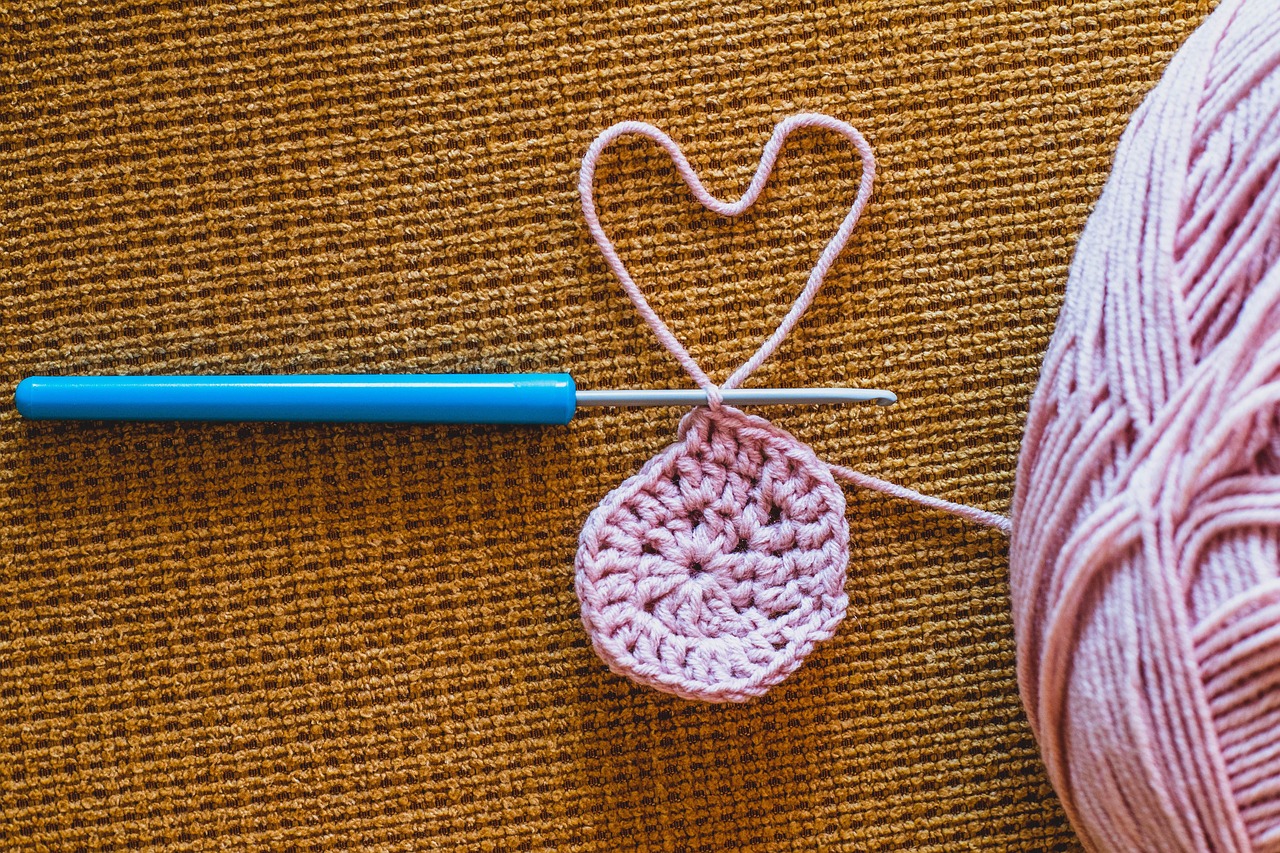
Learning how to crochet in the round is the key to hats, coasters, baskets, bags, mandalas and amigurumi. Instead of working back and forth in rows, you work around and around in rounds, starting from a small centre. This step-by-step tutorial covers how to start, the difference between joined and spiral rounds, the simple maths behind a flat circle, and how to crochet a tube for things like hats and bags.
Stitch names are given in US terms with UK terms in brackets. You'll need to know the chain, slip stitch and single crochet (UK double crochet); our basic crochet stitches guide covers all three.
What you need
- Smooth, light-colored worsted (UK aran) yarn
- A 5 mm (US H-8) hook, or the size recommended on your yarn label
- At least one stitch marker (a safety pin or scrap of yarn also works)
- A tapestry needle and scissors
Step 1: Choose how to start the circle
There are two common ways to begin.
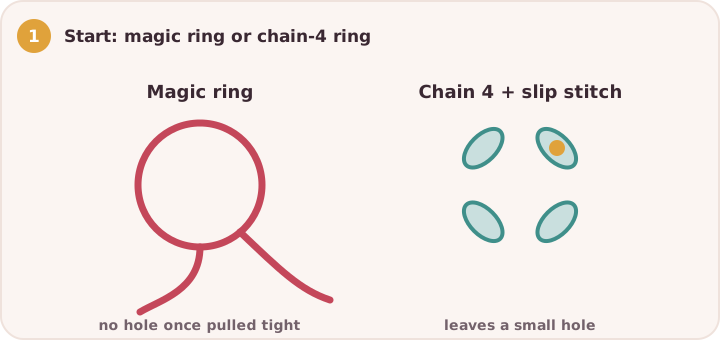
Option A: The magic ring (adjustable ring)
You make a loose loop of yarn, work the first round of stitches into it, then pull the tail to close the centre completely. It leaves no hole, which is why amigurumi patterns use it. Our full magic ring tutorial shows each step.
Option B: Chain and join
- Chain 4.
- Slip stitch into the first chain to form a small ring.
- Work the first round of stitches into the centre of the ring.
This is easier for some beginners but leaves a small hole in the middle, which is fine for granny squares and mandalas.
Step 2: Work the first round
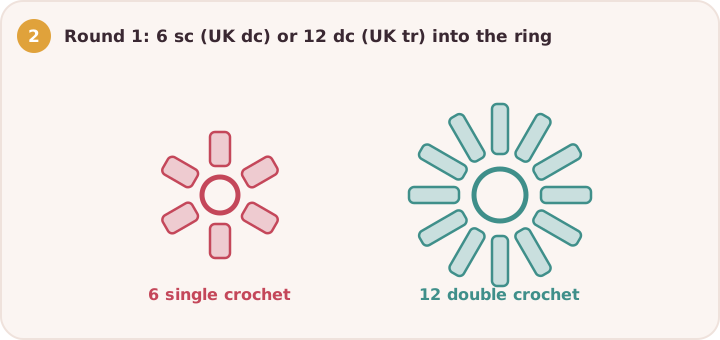
For a single crochet circle, work 6 single crochet (UK double crochet) into the ring. For a double crochet circle, chain 3 (this usually counts as the first stitch) and work 11 more double crochet (UK treble), for 12 in total.
Pull the magic ring tail to close the centre if you used one.
Step 3: Decide between joined and spiral rounds
This is the biggest choice in round crochet, and patterns will always tell you which to use.
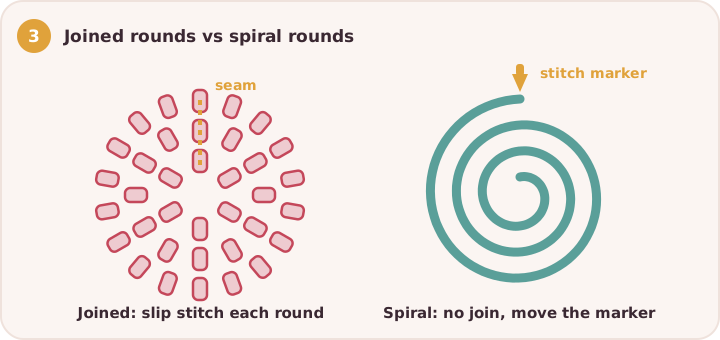
Joined rounds
At the end of each round, slip stitch into the top of the first stitch, then chain up (ch 1 for single crochet, ch 2 or 3 for double crochet) and start the next round.
- Pros: each round is clearly finished; easy to count; clean color changes.
- Cons: a visible seam line where every round begins.
Spiral (continuous) rounds
You don't join. After the last stitch of a round, you go straight into the first stitch of the next round.
- Pros: no seam, smooth fabric; standard for amigurumi.
- Cons: it's easy to lose your place, so a stitch marker is essential.
Using a stitch marker in spirals: place the marker in the first stitch of each round. When you get back to it, remove it, work that stitch, and put the marker back in the new stitch.
Step 4: Increase to keep the circle flat
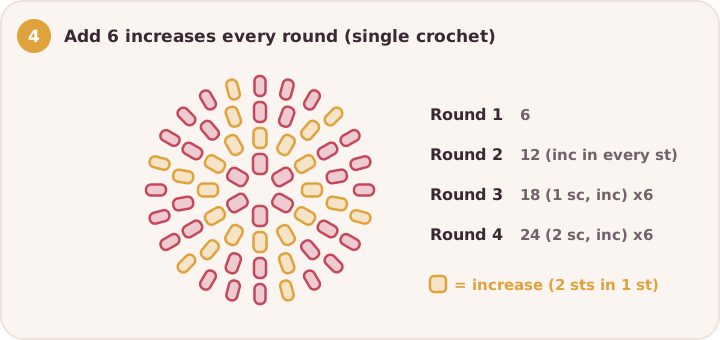
For a circle to lie flat, you need to add the same number of stitches every round as you had in the first round, spaced evenly. An increase means two stitches in the same stitch (see our step-by-step guide to increasing and decreasing).
Single crochet circle (6 increases per round)
| Round | What to do | Stitch count |
|---|---|---|
| 1 | 6 sc in ring | 6 |
| 2 | Increase in every stitch | 12 |
| 3 | (1 sc, inc) repeat 6 times | 18 |
| 4 | (2 sc, inc) repeat 6 times | 24 |
| 5 | (3 sc, inc) repeat 6 times | 30 |
| 6 | (4 sc, inc) repeat 6 times | 36 |
Notice the pattern: in each round, the number of plain stitches between increases goes up by one.
Double crochet circle (12 increases per round)
| Round | What to do | Stitch count |
|---|---|---|
| 1 | 12 dc in ring | 12 |
| 2 | Increase in every stitch | 24 |
| 3 | (1 dc, inc) repeat 12 times | 36 |
| 4 | (2 dc, inc) repeat 12 times | 48 |
Taller stitches cover more distance, so they need more increases per round to stay flat.
Avoiding a hexagon shape
If you always increase in the same place, a single crochet circle slowly turns into a hexagon. To keep it round, stagger the increases: in some rounds, start with half the plain stitches, then the increase, and finish with the other half.
Step 5: Crochet a tube (no increases)
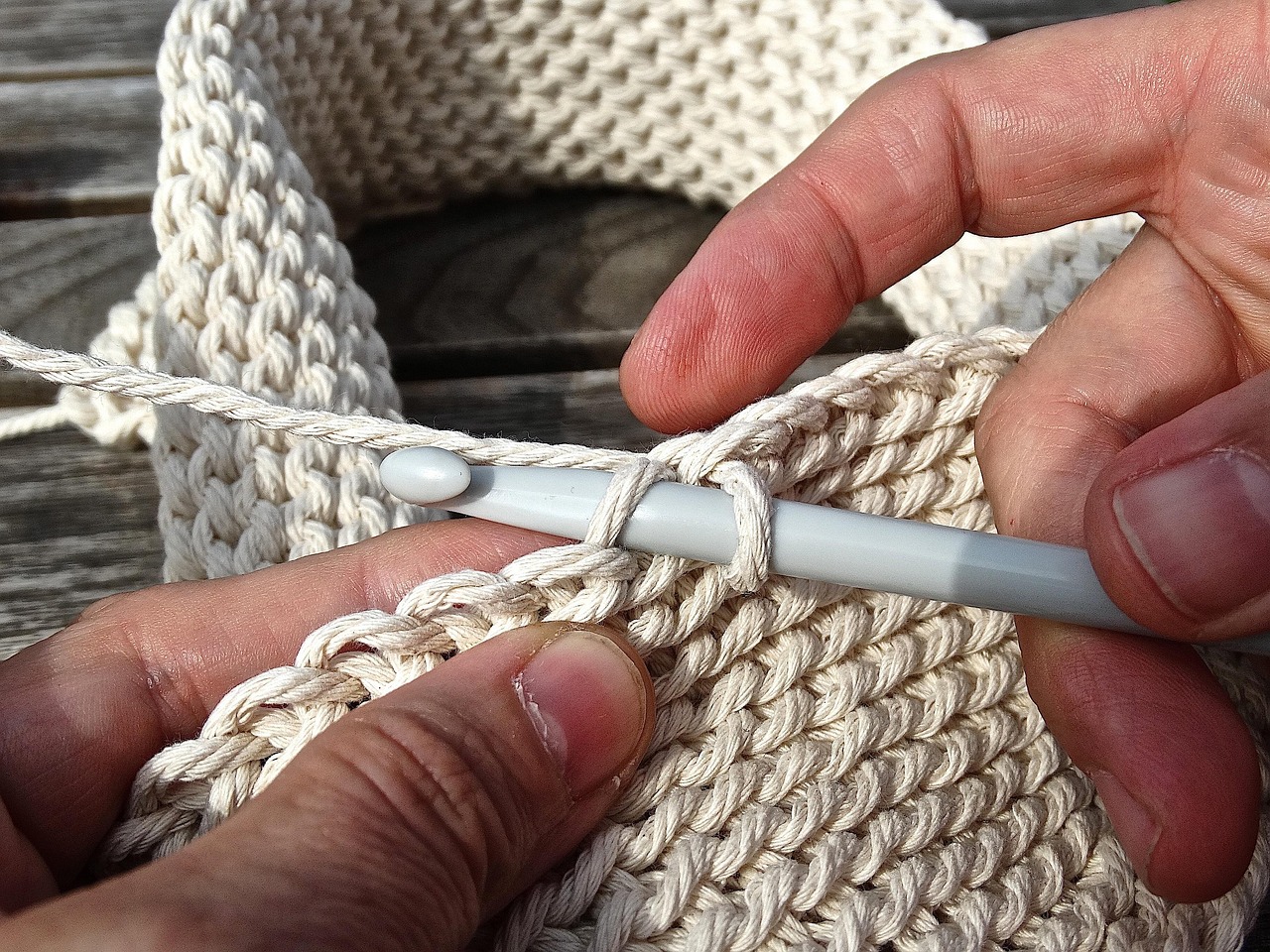
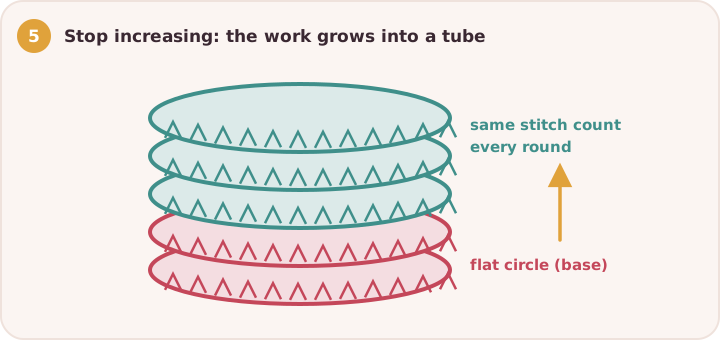
Once a circle is the right size, for example the crown of a hat or the base of a basket, simply stop increasing. Work one stitch in each stitch around, and the work will grow upwards into a tube.
You can also make a tube without a base:
- Chain the length you need.
- Check that the chain is not twisted.
- Slip stitch into the first chain to join.
- Work stitches around the chain, round after round.
Step 6: Finish off
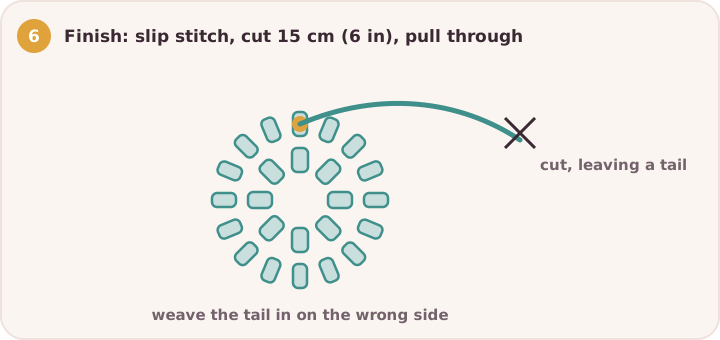
Cut the yarn leaving about 15 cm (6 in). For a neat edge on joined rounds, slip stitch into the first stitch, pull the tail through and weave it in. In spirals, slip stitch into the next stitch or two to smooth out the step at the end of the last round.
Troubleshooting
| Problem | Cause | Fix |
|---|---|---|
| Circle ruffles or waves | Too many increases | Check the count each round; don't increase extra |
| Circle cups into a bowl | Too few increases, or tight tension | Add missing increases, or go up one hook size |
| Lost count in a spiral | No stitch marker | Always move the marker each round |
| Seam slants across the work | Normal in joined rounds | Turn your work at the end of each round, or work in spirals |
| Twisted tube | Chain twisted before joining | Lay the chain flat before you join |
Frequently asked questions
What does "work in the round" mean? It means working in a continuous circle or tube instead of back and forth in rows.
Should I join rounds or work in a spiral? Follow your pattern. Joined rounds are easier to count and better for color changes; spirals are smoother and standard for amigurumi.
How many stitches do I start with for a crochet circle? Usually 6 for single crochet (UK double crochet) and 12 for double crochet (UK treble), then add that same number every round.
Why does my crochet circle curl up? It needs more stitches. Check you increased in every round, or try a larger hook.
Key takeaways
- Start with a magic ring (no hole) or a chain-4 ring.
- Joined rounds are easy to count; spiral rounds have no seam but need a stitch marker.
- For a flat circle, add the same number of stitches every round: 6 for sc, 12 for dc.
- Stagger increases to keep circles round instead of hexagonal.
- Stop increasing and you get a tube, the basis of hats, bags and baskets.