How to Increase and Decrease in Crochet: Step-by-Step Guide (sc2tog, dc2tog, Invisible Decrease)
Knowing how to increase and decrease in crochet is what turns flat rectangles into hats, toys, sweaters and anything with shape. An increase adds a stitch, a decrease removes one, and both are easier than they sound. In this step-by-step tutorial you'll learn the standard increase, the two most common decreases (sc2tog and dc2tog), the invisible decrease used in amigurumi, and how to place them so your work stays neat.
Stitch names are in US terms with UK terms in brackets. If you need a refresher on the stitches themselves, see our basic crochet stitches guide.
What you need
- Smooth, light-colored yarn so you can see your stitches (worsted / UK aran is ideal)
- A matching hook, for example 5 mm (US H-8)
- Stitch markers
- A short swatch of about 15 stitches to practice on
Abbreviations you'll see in patterns
| Abbreviation | US meaning | UK equivalent |
|---|---|---|
| inc | increase (2 stitches in the same stitch) | inc |
| sc2tog | single crochet 2 together | dc2tog |
| hdc2tog | half double crochet 2 together | htr2tog |
| dc2tog | double crochet 2 together | tr2tog |
| inv dec | invisible decrease | inv dec |
Patterns written in UK terms use the UK names, so always check which terminology a pattern uses. Our US vs UK crochet terms guide explains the full conversion.
How to increase in crochet
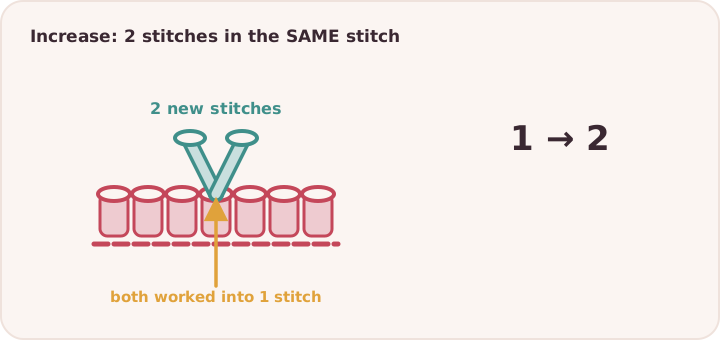
An increase means working two stitches into the same stitch. It works the same way for every stitch type.
Step 1: Work a stitch as usual
Make one stitch, for example a single crochet (UK double crochet), into the next stitch.
Step 2: Work a second stitch into the same place
Insert the hook into the same stitch again and make a second identical stitch.
Step 3: Count
Where there was one stitch, there are now two. Your row or round has one more stitch than before.
Tip: a pattern may say "3 sc in next st" or "dc, ch 1, dc in same st". These are also increases, just bigger or decorative ones.
How to decrease in crochet: sc2tog (UK dc2tog)
A decrease joins two stitches at the top so they become one. The idea is to start each stitch but finish them together.
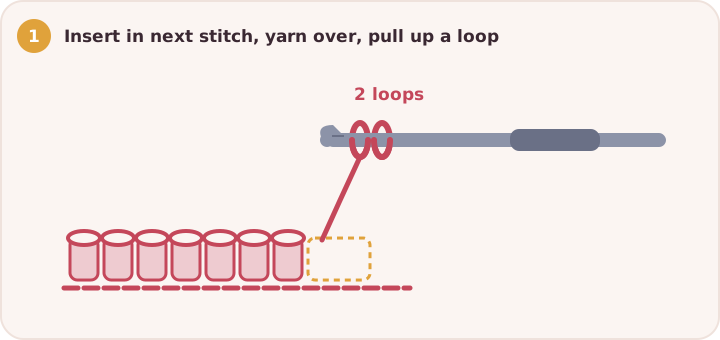
Step 1: Pull up a loop in the first stitch
Insert the hook into the next stitch, yarn over and pull up a loop. You have 2 loops on the hook.
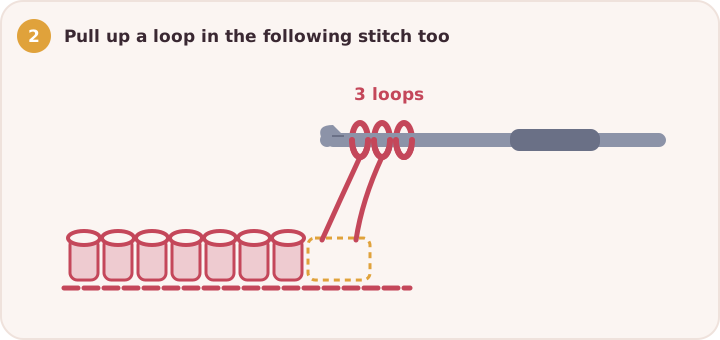
Step 2: Pull up a loop in the second stitch
Without finishing, insert the hook into the following stitch, yarn over and pull up a loop. You have 3 loops on the hook.
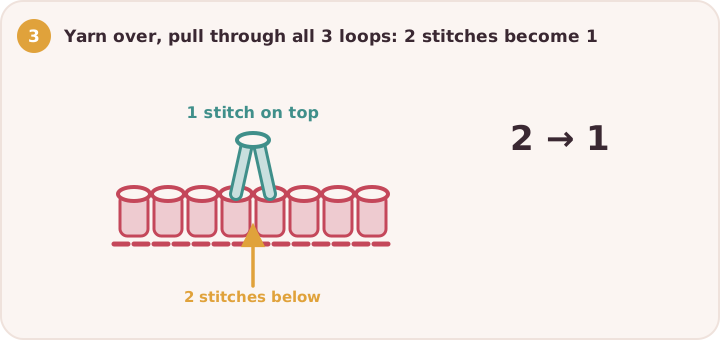
Step 3: Finish both stitches together
Yarn over and pull through all 3 loops. Two stitches have become one.
How to decrease in double crochet: dc2tog (UK tr2tog)
Step 1: Start the first double crochet
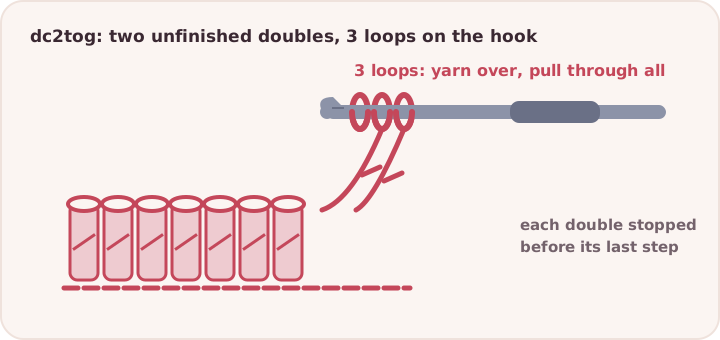
Yarn over, insert the hook into the next stitch, yarn over and pull up a loop (3 loops). Yarn over and pull through 2 loops. You have 2 loops on the hook. Stop.
Step 2: Start the second double crochet
Yarn over, insert the hook into the next stitch, yarn over and pull up a loop (4 loops). Yarn over and pull through 2 loops. You have 3 loops on the hook.
Step 3: Finish together
Yarn over and pull through all 3 loops.
The half double crochet version (hdc2tog, UK htr2tog) follows the same idea: yarn over, insert, pull up a loop in each of two stitches (5 loops), then yarn over and pull through all 5.
The invisible decrease (best for amigurumi)
A standard sc2tog can leave a small gap or bump, which shows on toys stuffed with fiberfill. The invisible decrease is neater.
Step 1: Insert into two front loops
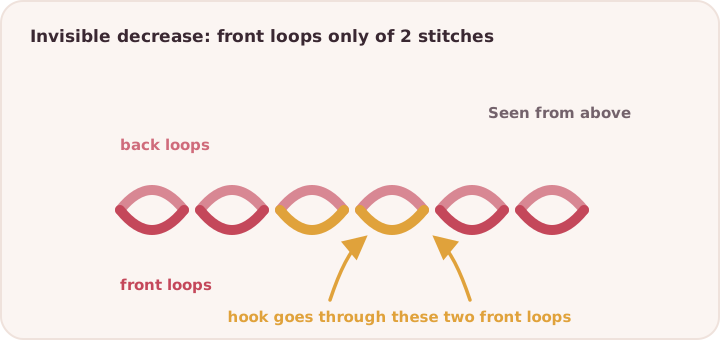
Insert the hook into the front loop only of the next stitch, then straight into the front loop only of the following stitch. You have 3 loops on the hook.
Step 2: Pull through both front loops
Yarn over and pull through the two front loops. You have 2 loops on the hook.
Step 3: Finish
Yarn over and pull through both loops.
Where to place increases and decreases
Along the edges (flat pieces)
To widen or narrow a flat piece, such as a triangle shawl or a sleeve, work increases or decreases in the first and last stitches of a row, or one stitch in from the edge for a smoother edge.
Evenly across a row
A pattern may say "increase 6 stitches evenly across". Divide the number of stitches by the number of increases to know how often to increase. For example, 30 stitches with 6 increases: increase in every 5th stitch.
In the round
Flat circles grow by adding the same number of stitches every round. For single crochet, that's usually 6 per round; for double crochet, usually 12. We explain this in detail in the in-the-round tutorial on this site, and you'll use the same principle when starting with a magic ring.
Common mistakes and how to fix them
| Problem | Likely cause | Fix |
|---|---|---|
| Work gets wider without meaning to | Accidental increase at the start or end of a row | Count stitches every row; mark first and last stitch |
| Work gets narrower | Skipping the last stitch or turning chain | Mark the last stitch with a stitch marker |
| Holes where you decreased | Standard decrease on a tight fabric | Use the invisible decrease, or a smaller hook |
| Circle ruffles | Too many increases | Follow the standard increase rate per round |
| Circle cups | Too few increases | Add increases or check your count |
Frequently asked questions
What does "inc" mean in crochet? It means increase: work two stitches into the same stitch.
What is the difference between sc2tog and an invisible decrease? Both turn two stitches into one. Sc2tog uses both loops of each stitch; the invisible decrease uses only the front loops, so it's flatter and less visible, which is why amigurumi patterns prefer it.
Do I count a decrease as one stitch? Yes. A decrease always counts as one stitch in the next row or round.
Can I decrease by skipping a stitch? You can, but it leaves a visible hole. Working two stitches together is neater and keeps the fabric solid.
Key takeaways
- An increase = two stitches in the same stitch; a decrease = two stitches finished together.
- For sc2tog (UK dc2tog): pull up a loop in two stitches, then yarn over through all 3 loops.
- For dc2tog (UK tr2tog): work each double crochet to the last step, then finish them together.
- Use the invisible decrease for toys and stuffed shapes.
- Count your stitches after each row or round and use stitch markers to stay on track.