How to Change Colors in Crochet: Step-by-Step Tutorial for Clean Color Changes
Learning how to change colors in crochet opens the door to stripes, granny squares, colorwork blankets and festive projects. The good news: the basic method is the same for almost every stitch. You simply finish the last stitch of the old color with the new color. This step-by-step tutorial shows you exactly how to do it at the end of a row, in the middle of a row and in the round, so your color changes look clean and tidy.
All stitch names are given in US terms, with the UK equivalent in brackets. If you're new to the stitches themselves, start with our guide to basic crochet stitches.
What you need
- Yarn in at least two colors, in the same weight and fiber so the fabric stays even
- A crochet hook that suits your yarn (for example 5 mm / US H-8 for worsted / UK aran)
- Scissors
- A tapestry (yarn) needle to weave in the ends
- Optional: a stitch marker to mark where you changed color
The golden rule of color changes
Every crochet stitch ends with a final yarn over and pull through. The loop left on your hook after that final step belongs to the next stitch. That's why you switch colors on the last yarn over of the previous stitch: the loop that sits on your hook is then already in the new color, and the next stitch starts cleanly.
If you finish the stitch completely in the old color and only then pick up the new one, you'll see a little "tail" of the old color on top of the first new stitch.
How to change colors at the end of a row (stripes)
This is the method you'll use most, for striped scarves, blankets and dishcloths.
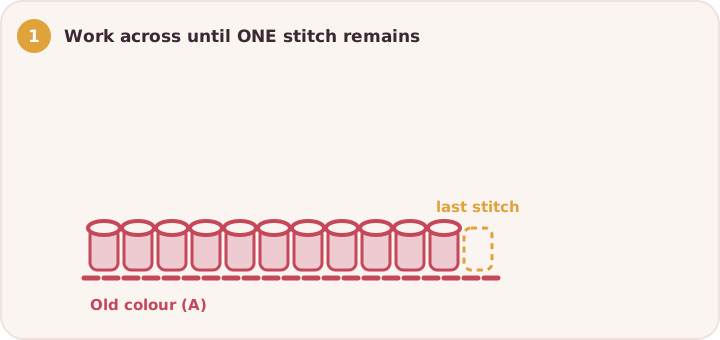
Step 1: Work to the last stitch
Crochet across the row in the old color until one stitch remains.
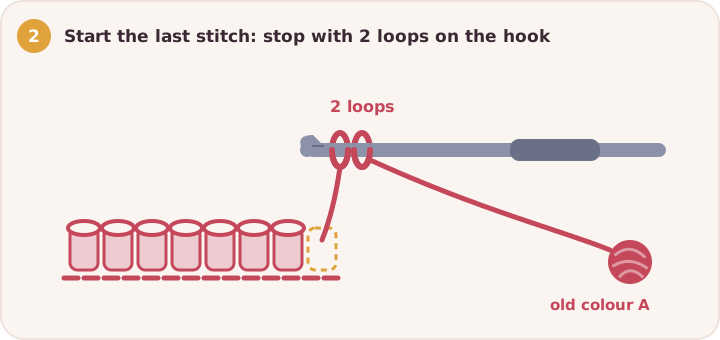
Step 2: Start the last stitch, but stop before the final yarn over
- Single crochet (UK double crochet): insert the hook, yarn over, pull up a loop. You now have 2 loops on the hook. Stop.
- Double crochet (UK treble): yarn over, insert the hook, yarn over, pull up a loop, yarn over, pull through 2 loops. You now have 2 loops on the hook. Stop.
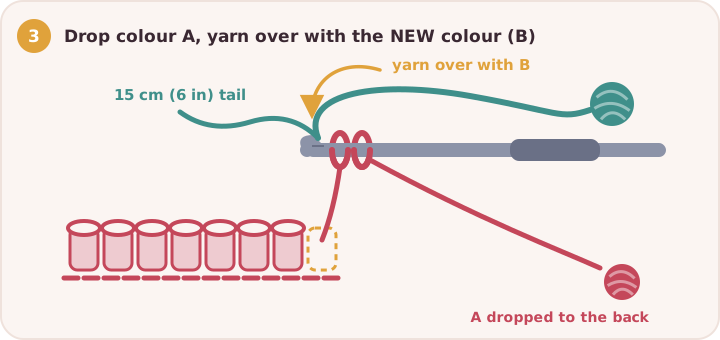
Step 3: Yarn over with the new color
Leave a tail of about 15 cm (6 in) of the new color. Drop the old color to the back, pick up the new color and yarn over with it.
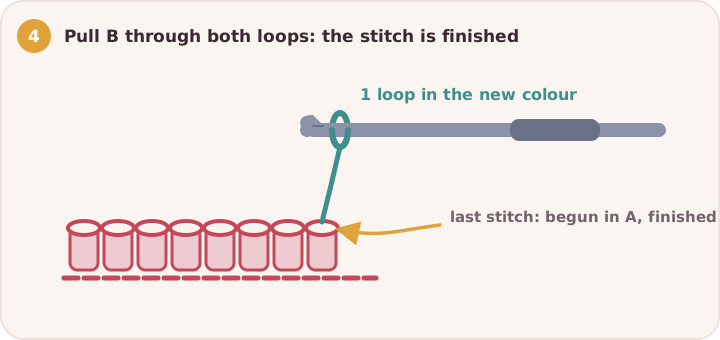
Step 4: Pull through to complete the stitch
Pull the new color through both loops. The stitch is finished and the loop on your hook is the new color.
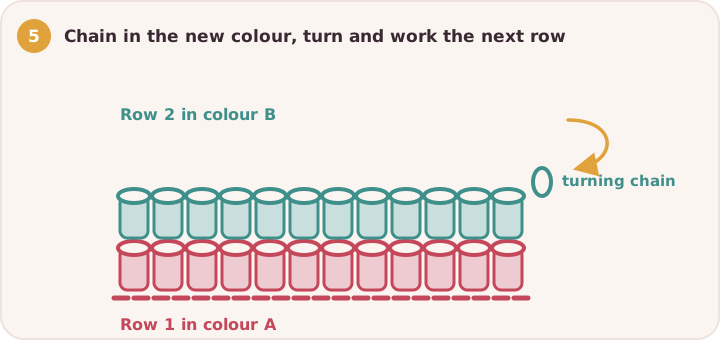
Step 5: Turn and continue
Make your turning chain in the new color, turn and work the next row as usual. Cut the old color, leaving a 15 cm (6 in) tail, unless you'll use it again in two rows (see "carrying yarn" below).
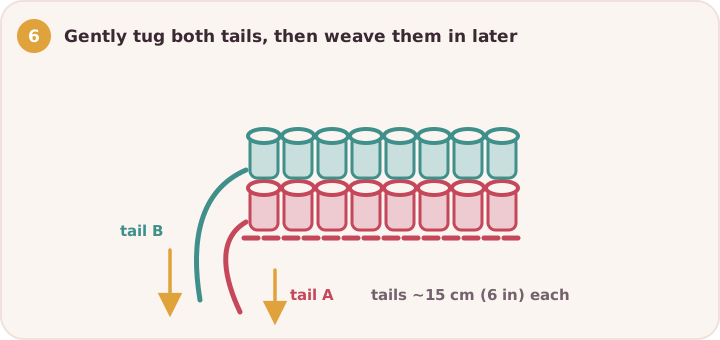
Step 6: Secure the tails
Gently tug both tails so the first stitch is snug. You can tie them in a loose temporary knot, but untie it before you weave in the ends so the edge stays flat.
How to change colors in the middle of a row
The method is exactly the same: work the stitch before the color change until 2 loops remain, then finish it with the new color. The next stitch is entirely in the new color.
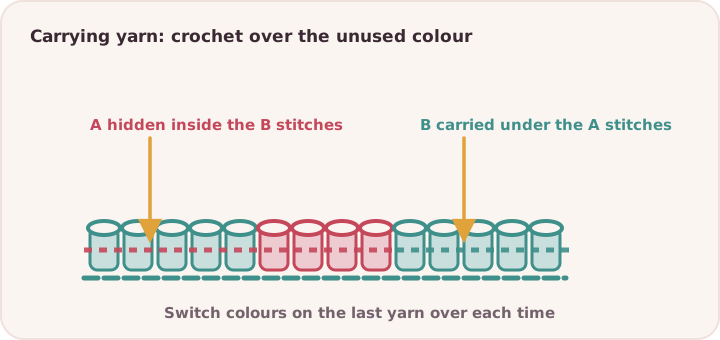
For short sections (such as letters, hearts or tapestry patterns), you don't have to cut the old color each time:
- Lay the unused color along the top of the stitches you're about to work into.
- Crochet over it, so it's hidden inside the new stitches.
- When you need it again, it's right there: switch back on the last yarn over.
This is called carrying the yarn. It works best with single crochet (UK double crochet), which hides the carried strand well. Keep the carried strand relaxed; pulling it tight will make the fabric pucker.
How to change colors in the round
When you work in joined rounds, such as granny squares or hats, there are two common methods.
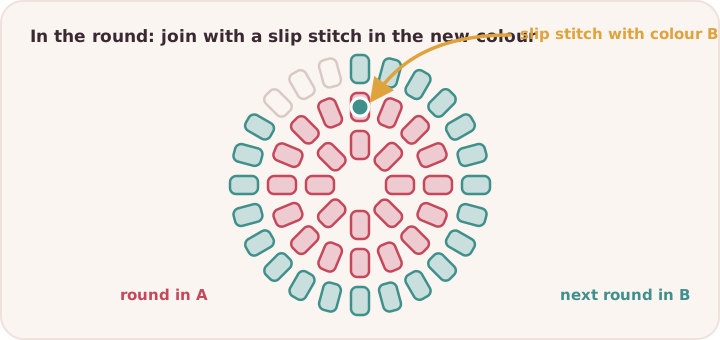
Method 1: Join with a slip stitch in the new color
- Finish the round in the old color.
- Insert the hook into the top of the first stitch of the round.
- Yarn over with the new color and pull it through the stitch and the loop on the hook (slip stitch).
- Chain up in the new color and start the next round.
Method 2: Fasten off and start a new color elsewhere
Fasten off the old color completely, then attach the new color in a different spot with a slip stitch (or a standing stitch, where you start a stitch directly with a slip knot on the hook). This avoids a visible column where every round begins. It's the method used in our classic granny square tutorial, where each round can start in a new corner.
What about spiral rounds?
In continuous spiral rounds (common in amigurumi), color changes create a small "jog", a step where the old and new rounds meet. To soften it, change color on the last yarn over as usual, then work the first stitch of the new color as a slip stitch instead of a full stitch. It won't disappear completely, but it becomes much less visible.
Common mistakes and how to fix them
| Problem | Cause | Fix |
|---|---|---|
| Old color peeks on top of the first new stitch | Changed color after finishing the stitch | Switch on the last yarn over of the previous stitch |
| Loose, gappy first stitch | Tails not tightened | Tug both tails gently before continuing |
| Fabric puckers in colorwork | Carried yarn pulled too tight | Spread your stitches before switching back |
| Holes at the color change | Tension changes when you swap strands | Hold both yarns lightly for the first stitch |
| Too many ends to weave in | Cutting yarn for every stripe | Carry yarn up the side for stripes of 2 rows |
Carrying yarn up the side: for stripes that alternate every two rows, don't cut the yarn. Leave it at the edge and pick it up when you need it again, loosely catching it in the first stitch. This saves a lot of weaving in.
Weaving in the ends
Thread each tail onto a tapestry needle and weave it through the back of stitches of the same color, going in one direction and then back again for about 5 cm (2 in). Weave red tails into red stitches and white tails into white stitches so they stay invisible. Trim close to the fabric without cutting the stitches.
Frequently asked questions
Do you change colors before or after the last stitch? During it. Start the last stitch in the old color and use the new color for the final yarn over.
Should I tie a knot when changing yarn colors? It's better not to leave a permanent knot. Knots can work loose or show on the front. Weaving in the ends properly is more secure.
How long should the yarn tail be? About 15 cm (6 in) is enough to weave in comfortably.
Can I change colors with any stitch? Yes. Whatever the stitch, stop before the final yarn over and complete it with the new color. For more practice, try a striped first project from our crochet for beginners guide.
Key takeaways
- Change colors on the last yarn over of the stitch before the new color starts.
- At the end of a row, make the turning chain in the new color.
- Carry unused colors inside your stitches for small colorwork sections.
- In the round, join with a slip stitch in the new color or start in a new spot to hide the seam.
- Leave 15 cm (6 in) tails and weave them into stitches of the same color.